Gemini GEO Whitepaper: From Audit to Growth
Introduction
How AI search is changing the way brands get discovered
For more than a decade, marketing teams have measured digital performance the same way: search rankings, website traffic, ad clicks, and lead conversion. As long as your brand site reached the first page of search results, you had a chance of earning the click — and turning visitors into customers.
Generative AI search is disrupting that model.
When users start asking Google Gemini questions, they no longer "search keywords, browse results, and compare on their own." Instead, they "ask one question, read one synthesized answer, and trust what the AI recommends." In this flow, the real question becomes: does your brand appear in the answer? Does the AI recommend you? Does it treat your content as a source worth citing?
For marketing leaders, this creates a problem that didn't exist a few years ago:
When a buyer asks Gemini about your industry, product, service, or solution — will your brand appear in the answer?
If the answer is no, even a great traditional search ranking will still lose at the critical moment of AI search. Worse, your competitors may already be mentioned, recommended, and cited in those answers — while you have no way of knowing.
GNS-GEO calls this problem Gemini search visibility. It's not just about whether AI mentions your brand. It's about your share of voice versus competitors, the sentiment AI expresses about you, whether your content gets cited, and whether your website was built from day one for AI to crawl and understand.
This whitepaper walks you through the shift: from traditional SEO ranking thinking to AI visibility growth thinking; how a GEO audit reveals your brand's true position in Gemini; how to turn competitive gaps and citation sources into content and distribution strategy; and how GNS-GEO builds a closed loop — audit, optimize, content, monitor, analyze — so your AI search visibility compounds over time.
The core argument of this whitepaper
In the Gemini search era, getting buyers to see your brand is no longer enough. AI must correctly understand you, describe you positively, and keep recommending you.
Chapter 01 — Why Businesses Can't Afford to Ignore Gemini Visibility
You can rank well in search and still be invisible in Gemini answers
In traditional search, a buyer types keywords, scans the results page, clicks several sites, and compares brands, products, and services on their own. The marketing team's core job is to push the homepage, landing pages, or articles as high up the results page as possible.
In AI search, that decision path is collapsing. Buyers don't necessarily click through a list of pages anymore — they ask Gemini directly:
- "Who is the most trusted GEO provider?"
- "How is AI search optimization different from SEO?"
- "Which company can tell me how visible my brand is in Gemini?"
- "How do I know if competitors are being recommended by Gemini?"
Gemini pulls information from every source it can access, synthesizes an answer, and mentions, compares, or recommends a handful of brands within it. By the time a buyer accepts that curated shortlist, the competition is already over — before anyone ever visits your website.
The SEO era vs. the GEO era
| Dimension | SEO era | GEO era |
|---|---|---|
| Primary entry point | Search results page | Gemini-generated answers |
| What you compete for | Keyword rankings | Being mentioned, recommended, and cited in answers |
| Buyer behavior | Clicks multiple pages and compares on their own | Reads and trusts one synthesized answer |
| Marketing metrics | Rankings, traffic, CTR, conversion rate | Brand mentions, share of voice, citation rate, sentiment |
| Role of content | Earn the click | Become a source AI can understand, cite, and trust |
Five new questions on every marketing leader's desk
1. Your brand may be completely absent from Gemini answers
You may have invested heavily in SEO, paid search, website content, and social media — yet when a buyer asks Gemini, your brand is still entirely absent. You are effectively invisible at the new front door of brand discovery.
2. Competitors may already be recommended — and you have no way to know
Gemini answers often curate shortlists, recommend providers, and compare solutions for buyers. If a competitor keeps appearing and you don't, they shape the buyer's first impression of the whole category before you ever join the conversation.
3. Traditional SEO data can't explain AI exposure
Rankings, organic traffic, and click-through rates still matter, but they can't answer the questions that now decide success: Is your brand mentioned by Gemini? Does AI cite your website? Does it describe you positively? Where do competitors win?
4. Content teams don't know what to write
Many companies realize GEO needs content, yet fall straight into the "just publish more articles" trap. Without an audit first, content production becomes guesswork that never compounds into growth.
5. Marketing budgets need a new way to prove value
"We published X articles" is not an outcome. You have to argue with trackable metrics: brand mentions, share of voice, citation rate, and sentiment.
Chapter summary
AI search shifts competition from "fighting for rankings" to "fighting for a place in the answer." Marketing leaders need to know whether their brand has already entered Gemini answers — and where they stand versus competitors.
Wondering if your brand is being cited in Gemini? → Get your free Gemini GEO report
Chapter 02 — What "Gemini Search Visibility" Really Means
From rankings to recommendations: the metrics have changed
Traditional search marketing measures visibility with keyword rankings, impressions, click-through rates, and site traffic. These metrics answer only one thing: can buyers see you on the results page? Do they click?
Gemini search visibility asks a different question:
When Gemini writes its own answer, does your brand become part of it?
So Gemini search visibility isn't a single number — it's a set of metrics organized around one core idea: does AI see, understand, cite, and recommend your brand.
The core visibility metrics GNS-GEO tracks
1. Brand mentions
Whether your brand, product, or service name appears in Gemini answers. This is the most basic signal of AI visibility. No mention means you haven't entered Gemini's candidate pool for that question.
2. Share of voice
How much of the visibility between you and your direct competitors belongs to you. If competitors are named repeatedly and you rarely appear, your competitive share of voice in Gemini search is too low.
3. Citation rate
Whether your website, articles, case studies, or other content are used by Gemini as sources. Being mentioned means AI knows you exist; being cited means AI treats your content as trustworthy.
4. Sentiment
How Gemini describes your brand — positive, neutral, or negative. When AI associates your brand with words like "expert," "category leader," or "enterprise-ready," trust builds more easily.
5. Context coverage
How many user question contexts mention you. Appearing only for your brand name isn't stable AI visibility — you need coverage across comparison, recommendation, cost, and proof contexts.
6. Competitive gap
Where competitors outperform you — on which keywords, question contexts, and citation sources. This is the most actionable part of GEO.
What these metrics mean for your business
| Metric | Question for marketing leaders | Business meaning |
|---|---|---|
| Brand mentions | Does Gemini know my brand? | Decides whether you enter the buyer's AI decision flow |
| Share of voice | Who is Gemini more likely to name — us or competitors? | Measures your competitive position inside answers |
| Citation rate | Is my content becoming an AI source? | Measures the citation value of your content assets |
| Sentiment | How does Gemini describe my brand? | Shapes the buyer's first impression and trust |
| Context coverage | In which question contexts am I mentioned? | Measures whether visibility is stable and comprehensive |
| Competitive gap | Where are competitors ahead of me? | Sets priorities for content, website, and distribution |
Chapter summary
Gemini search visibility isn't a "do we get traffic?" question. It's whether your brand is mentioned, recommended, and cited in answers — and described in a way that builds trust.
Want to measure your Gemini visibility with real data? → Get your free report
Chapter 03 — Why You Need a GEO Audit Before Writing Any Content
GEO without diagnosis is just writing in the dark
When companies first meet GEO, they often interpret it as "write more AI-friendly content." That's not wrong — just incomplete. The problem: if you don't know how Gemini currently understands your brand, or why competitors get recommended, then jumping straight into articles and landing pages is a fast track to inefficient content production.
Effective GEO doesn't start with content — it starts with diagnosis: find your visibility gaps in Gemini first, then decide which content to create, which pages to optimize, and which citation sources to build.
The 7 questions every GEO audit must answer
1. Does your brand appear in Gemini answers?
If you're absent from core business questions, category recommendation questions, and product choice questions, building basic AI visibility is your first priority.
2. In which question contexts do you appear?
A brand may be mentioned for its own name while being completely absent from comparison and decision contexts like "who's best," "how much," and "is it worth it."
3. What is your share of voice versus competitors?
If your brand is mentioned 100 times but your main competitor 1,000 times, you have exposure — but your competitive share of voice is far too low.
4. Does Gemini describe you positively, neutrally, or negatively?
Appearing isn't the same as being understood correctly. You also need to know how AI describes you: accurately? Are your core strengths missing?
5. Which sources does Gemini cite?
The goal of GEO isn't just mentions — it's making your content a trusted source. You need to know what Gemini currently cites: your website, industry media, third-party reviews, or something else.
6. Which keywords do competitors win?
When competitors keep appearing for certain questions and you don't, those are your highest-priority GEO opportunities.
7. Is your website designed for AI crawling and understanding?
Schema, Sitemap, llms.txt, page speed, and content freshness all affect how efficiently Gemini reads and trusts your pages.
How GNS-GEO's audit logic works
- Diagnoses your brand's current performance in Gemini;
- Benchmarks competitors against the same keywords and questions;
- Finds opportunity keywords where competitors rank and you don't;
- Analyzes AI citation sources and content types;
- Generates actionable recommendations for website, content, and distribution;
- Continuously monitors changes in GEO score, mentions, share of voice, and citation rate.
Why you can't skip the audit
| Writing content without an audit | Writing content after a GEO audit |
|---|---|
| You don't know what buyers actually ask Gemini | You plan topics around real question contexts |
| You don't know which questions competitors are recommended for | You prioritize gaps where competitors rank and you don't |
| You don't know which sources AI cites | You build a distribution plan around the source types AI prefers |
| You can't tell whether published content works | You track changes in mentions, citation rate, and share of voice |
Q: We already work with an SEO agency — do we still need a GEO audit?
A: Yes. An SEO agency tracks keyword rankings and traffic, but those numbers can't tell you whether Gemini is citing your brand. A GEO audit asks a different set of questions: Is the brand mentioned? Cited? Described positively? The two run in parallel — GEO doesn't replace SEO, it helps you win back a place inside AI answers.
Chapter summary
Without a GEO audit, you can't know how Gemini understands your brand, or why competitors get recommended. The first step of GEO isn't writing content — it's diagnosing your brand's true position in AI search.
Want to see where your citation gap vs. competitors is? → Free GEO audit report
Chapter 04 — The GEO Score: A Scoring Model for Gemini Visibility
One number to master your brand's competitiveness in Gemini search
Marketing leaders need a single, explainable, trackable number to evaluate overall performance — that's what the GEO Score is for.
The GEO Score isn't just a count of brand mentions. It combines your appearance rate in answers, your share of voice versus competitors, the citability of your content, AI's sentiment about you, and how broadly you cover different question contexts.
The five factors behind the GEO Score
| Factor | Default weight | Definition | Business meaning |
|---|---|---|---|
| Appearance rate | 30% | Share of target queries where Gemini mentions your brand | Whether you enter AI answers |
| Share of voice | 25% | Your share of total mentions across you and competitors | Your visibility competitiveness versus competitors |
| Citation rate | 20% | How often Gemini uses your site or content as a source | Whether your content has become an AI source |
| Sentiment | 15% | How positive, neutral, or negative Gemini is about you | Whether AI understands you positively and accurately |
| Context coverage | 10% | How broadly you cover the tested question contexts | Whether your visibility is stable and comprehensive |
How to read your GEO Score
| Score range | What it means | What marketing leaders should do |
|---|---|---|
| 0–40 | Weak Gemini visibility | Prioritize basic appearance rate, site crawlability, and core content assets |
| 40–70 | Some exposure, clear room to grow | Strengthen opportunity keywords, citation sources, and content depth |
| 70+ | Strong Gemini visibility | Keep monitoring competitors and expand recommendations and citations on high-value questions |
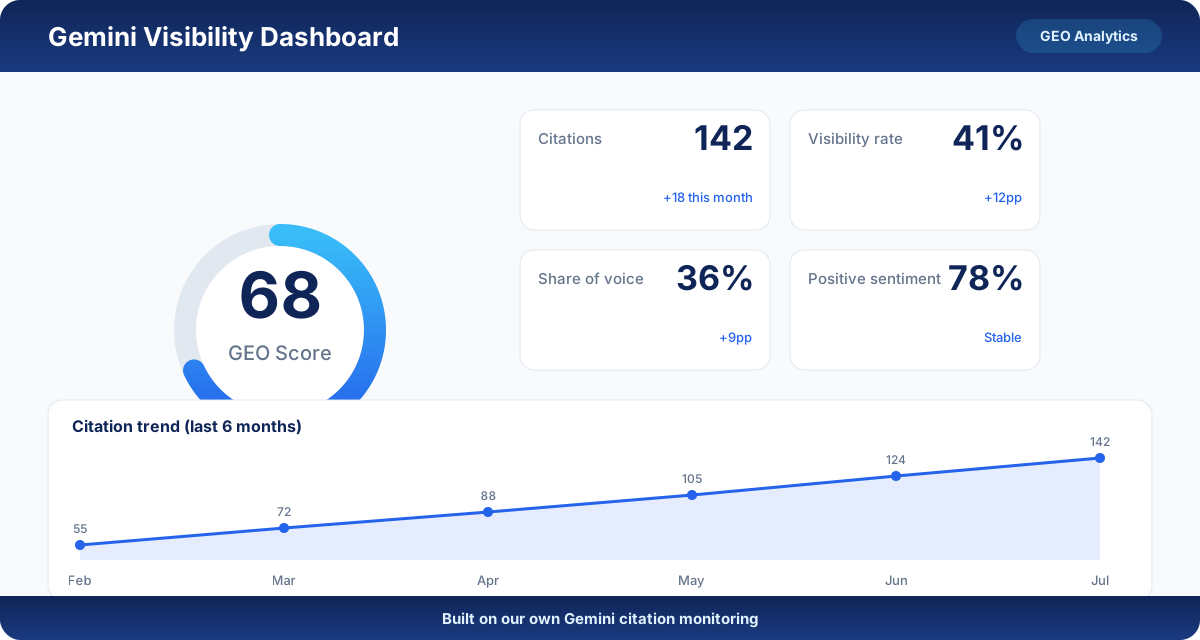
Figure: The GEO Score combines citation count, visibility rate, share of voice, and sentiment — a single view of your brand's competitiveness in Gemini.
Why the GEO Score matters for marketing management
- Before a project starts, it sets your AI visibility baseline;
- After content and optimization go live, it tells you whether those efforts moved the needle;
- Compared with competitors, it shows whether you're closing or widening the gap;
- In monthly reviews, it becomes the key metric you report to leadership.
Chapter summary
Gemini visibility isn't a feeling — it can be scored, monitored, and optimized. The GEO Score turns an abstract concept into a growth metric you can actually manage.
Want to know your GEO Score? → Get your free report
Chapter 05 — Why Competitors Get Recommended by Gemini and You Don't
Competition inside answers starts with share of voice
The question that keeps marketing leaders up at night usually isn't "is my brand appearing?" but:
Why is my competitor appearing and I'm not?
In Gemini search, buyers ask "which company is best," "which brands do you recommend," and "which provider is actually reliable." To answer, Gemini curates a shortlist from every source it can access. If competitors keep appearing in those answers, the buyer's first impression of the category — anchored on your competitors — forms earlier.
What competitor analysis should focus on
1. Total citations: competitors' baseline exposure in Gemini answers.
2. Share of voice: in a given category, Gemini may only recommend a few brands — the higher your share, the better your chance of entering the shortlist.
3. Keyword performance: which questions competitors get recommended for is a key GEO clue. Every question reflects a real buyer need — and a content opportunity you can capture.
4. Sentiment distribution: a competitor that isn't just mentioned but described as "leading," "mature," and "case-rich" carries more influence in answers.
5. Primary citation sources: why does Gemini cite competitors? More complete websites? More industry exposure? More third-party reviews? Find these sources and you can build a sharper strategy.
Anonymous case: what a GEO audit found for a Hong Kong B2B tech company
Take a Hong Kong B2B firm providing compliance and data services to fintech companies (anonymized at the client's request). GNS-GEO ran a Gemini visibility audit for it:
- Audit scope: 120 industry questions covering vendor recommendations, solution comparisons, pricing, and ROI scenarios
- Brand mentions: cited in only 5 questions, 3 of which were brand-name queries
- High-intent questions: absent from all 28 "recommend or compare vendors" questions — Competitor A appeared in 19 of them
- Cited sources: Gemini's cited sources were industry media and directories — the company's own site was never cited
- AI description: neutral but vague — "an IT services company," with no mention of its compliance expertise
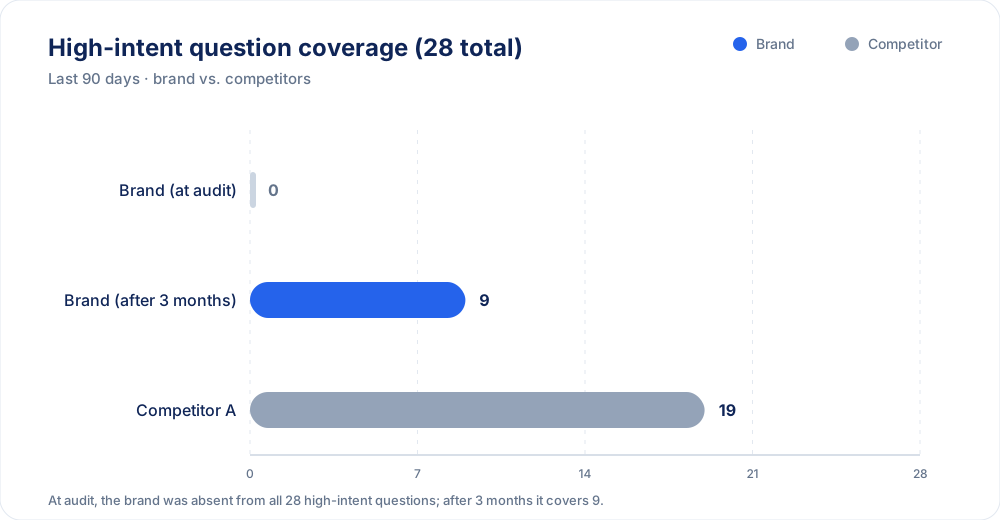
Figure: Brand vs. competitor coverage in high-intent questions over the past 90 days.
Why it was losing
- No direct answers or FAQ/Service schema on core pages;
- Content had not been updated in over two years;
- No brand profiles on directories (G2, Capterra) or industry media;
- Brand name was inconsistent between LinkedIn and the company website.
Three months later
After the first round of optimization (direct answers + schema, refreshed core pages, directory profiles, and case studies):
| Metric | At audit | After 3 months |
|---|---|---|
| GEO Score | 34 | 61 |
| Brand visibility rate | 8% | 41% |
| High-intent question coverage | 0/28 | 9/28 |
| Cited sources | 0 | 7 |
The lesson: the citation gap is a revenue gap — only when a brand starts appearing in high-intent questions does Gemini have a chance to put it on the recommended list.
Competitors usually lead for four reasons
- Their content is more complete — features, use cases, customer stories, specs, and FAQs are clearer, so AI can understand and cite them more easily.
- They have more external sources — appearing frequently on industry media, review articles, and Q&A platforms helps AI build multi-source understanding.
- Their websites are built for AI crawling — clear structure, fast loading, complete Schema and Sitemap.
- They occupied key questions earlier — buying guides, comparison articles, case pages, and FAQs became natural citation sources.
Turning competitive gaps into action
| Opportunity type | How to spot it | Recommended action |
|---|---|---|
| Competitor ranks, you don't | Competitor appears in answers, your brand doesn't | Prioritize GEO content for those questions |
| Competitor is cited, you aren't | AI cites competitor's site or external content | Restructure site content and build high-quality external sources |
| Competitor sentiment is better | AI describes competitor more positively | Add case studies, data, certifications, and proof |
Chapter summary
The first step of GEO isn't writing more — it's finding the questions where competitors are already recognized by Gemini and you have no coverage.
Want to see where competitors are beating you in answers? → Free GEO report
Chapter 06 — How Gemini Decides Which Sources to Cite
Gemini doesn't "look" at web pages; it judges credibility by reading content structure and signals. In our own Gemini citation monitoring, the citation decision is mainly influenced by five factors:
6.1 Relevance
How directly the answer relates to the question is the primary factor. Content must be written in the user's language and the way users ask questions — not internal corporate jargon.
6.2 Freshness
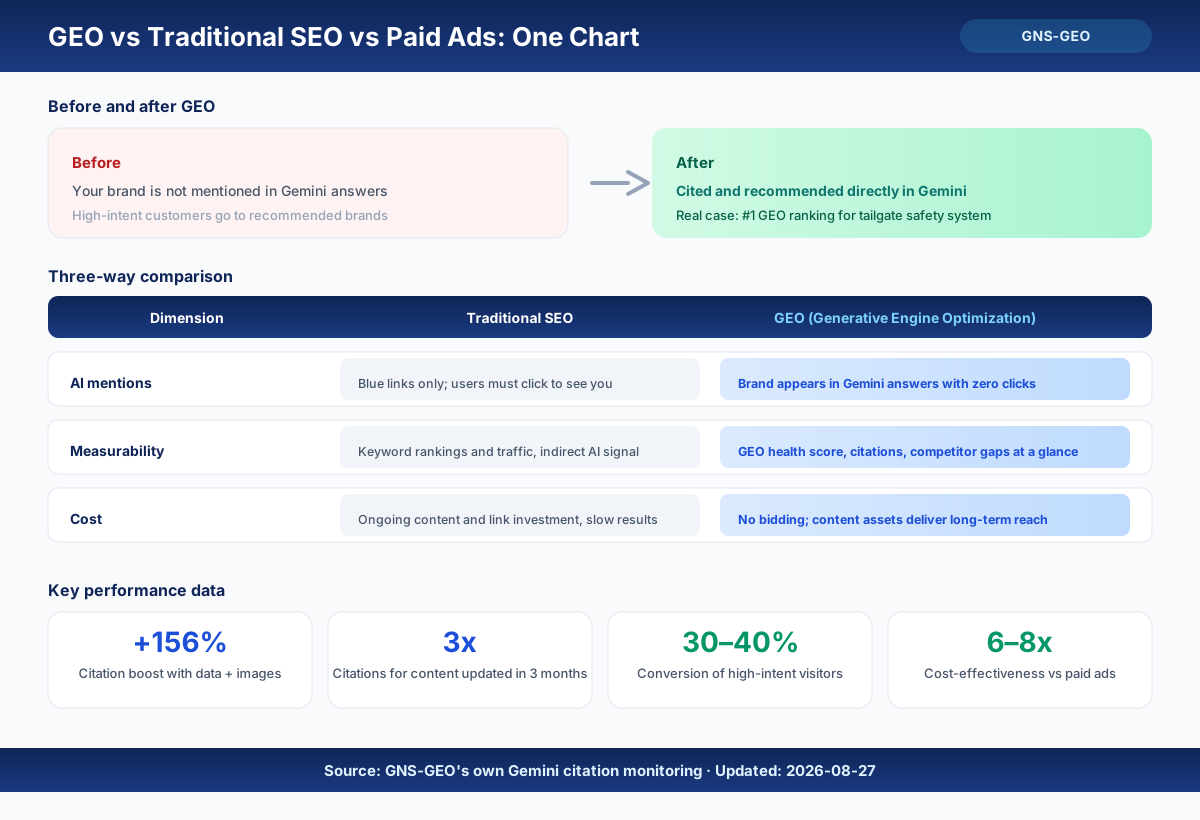
Content updated within the last 3 months is cited 3x more often. A corporate website that never changes sends AI the signal that "this content is outdated."
6.3 Schema readiness
JSON-LD structured data such as Organization, LocalBusiness, FAQPage, and Article lets Gemini confirm your brand identity, service scope, and content types. Without Schema, your brand is just an "unverifiable claim" to AI.
6.4 Authority signals (E-E-A-T)
Experience, expertise, authoritativeness, and trustworthiness. Author identity, third-party citations, industry media endorsements, and real customer reviews are concrete evidence of E-E-A-T.
6.5 Direct answers and citability
Content that states its conclusion in the first paragraph, stays around 134–167 characters, and includes verifiable data is easiest for Gemini to cite directly. Content with images and structured data can be cited up to 156% more often.
Q: Why does Gemini keep citing Wikipedia and industry media instead of our website?
A: Gemini tends to cite sources it considers credible — Wikipedia, industry media, directories. Your website matters, but without third-party authority signals, AI assumes you're just talking about yourself. A big part of GEO is building those external citations (see the competitor analysis in Chapter 05).
Chapter summary
Gemini's citation logic comes down to one sentence: only content that is easy to understand, easy to verify, and easy to cite becomes an AI answer source.
Want to know if your site has "citation signals"? → Get your free report
Chapter 07 — From Audit to Recommendations
Diagnosis is step one — the real value is knowing what to do next
The value of a GEO audit report isn't just telling you your current score. It answers: why isn't the score higher? Where's the problem? What should we do first?
The GNS-GEO recommendation framework
1. Content gap recommendations
Reveal the opportunity keywords where competitors rank and you don't. Every question should become a website article, solution page, FAQ, case study, or industry guide.
2. Website technical recommendations
Add Organization, Product, Service, FAQ, and Article Schema; check that robots allows crawling of core pages; complete your Sitemap; improve page speed; plan llms.txt; strengthen internal linking.
3. Citation source recommendations
If Gemini frequently cites industry media, research reports, or third-party reviews for a category of questions, publish where AI is most likely to find and trust your content.
4. Competitor catch-up recommendations
| Priority | Criteria | Recommended action |
|---|---|---|
| High | Competitor appears often; you don't at all | Plan content and distribution immediately to capture key contexts |
| Medium | Competitor has exposure; yours is low | Improve existing content, add case studies and citation sources |
| Low | Both you and competitors have low exposure | Keep as a long-term content asset reserve |
5. Context gap recommendations
When you're strong on brand terms but weak on comparison and decision contexts, adjust strategy by context: strengthen comparison pages, FAQs, and case studies to cover key contexts like "who's best" and "how much."
From report to action: coordinating the marketing team
| Role | GEO responsibility |
|---|---|
| Marketing leader | Set target questions, competitors, keyword priorities, and budget |
| Content team | Create articles, FAQs, case studies, and guides for opportunity keywords |
| SEO / web team | Optimize page structure, Schema, internal links, Sitemap, and speed |
| PR / brand team | Publish press releases, industry media, third-party endorsements, and brand voice |
| Sales team | Feed back the questions buyers actually ask and real case stories |
Chapter summary
The real value of a GEO audit is turning data into concrete action. What you need isn't a report — it's recommendations that are actionable, prioritized, and reviewable.
Want prioritized next-step recommendations? → Contact GNS-GEO
Chapter 08 — Content & Distribution: Making Gemini More Likely to Cite You
The goal isn't more content — it's content AI will actually cite
Effective GEO content comes from data: what buyers ask, what Gemini answers, why competitors get cited, and what content you're missing.
Finding opportunity keywords
Opportunity keywords usually come from real buyer question contexts:
- Solution questions: which solution fits a company like ours?
- Recommendation questions: which providers are worth choosing?
- Product choice questions: how do I compare these products?
- Cost and ROI questions: how is the ROI of this service calculated?
- Proof questions: are there real case studies?
Which content types are more likely to be cited by Gemini
| Content type | Question it answers | Where to publish |
|---|---|---|
| Industry guide | Helps buyers understand problems and solutions | Resource center, owned channels |
| Comparison article | Helps buyers compare products, services, or providers | Blog, topic pages |
| FAQ page | Directly answers the questions AI and buyers ask most | Website FAQ, solution pages |
| Case study | Proves capability and real results | Case pages, sales collateral |
| Whitepaper / report | Builds methodology and authority | HTML topic pages, PDF download |
Content that is easier for Gemini to understand usually has: a clear title, explicit H2/H3 structure, tables and lists, an objective tone, data and third-party sources, crawlable pages, and ongoing freshness.
Publishing and monitoring
After content is finished, it must travel through paths AI can discover: your official website, directory platforms (G2, Capterra), and industry media. Publishing isn't the finish line — keep tracking whether content moves brand mentions, citation rate, and share of voice, and use the data to adjust titles, structure, and distribution channels.
Q: We've published lots of blog posts — why does Gemini still not cite us?
A: Quantity doesn't equal citability. Gemini cites content that answers questions directly, is clearly structured, and is supported by data — if your posts have no direct answers, no schema, and no third-party citations behind them, publishing more won't help. A GEO audit tells you what Gemini actually cites, so you can write what matters (see Chapter 03).
Chapter summary
GEO content isn't mass-producing ordinary articles. It's building content assets that genuinely have a chance to enter Gemini answers, based on audit and competitor citation data.
Want to know which content Gemini will actually cite? → Free GEO report
Chapter 09 — Your Website Is the Foundation of Gemini Visibility
If AI can't understand your website, no amount of content builds authority
Your website is your most important owned source. For Gemini, it's usually the primary entry point for understanding your brand identity, products, services, and authority.
But many corporate sites share the same problem: pages look complete and read well for humans, yet aren't designed for AI to crawl, parse, and cite.
Website technical checklist
- Structured data (Schema): Organization, LocalBusiness, FAQPage, Article;
- Crawlability: robots allows crawling of core pages, and important content isn't script-rendered;
- Sitemap: complete and ensure important pages are indexed;
- llms.txt: helps AI quickly understand your site's core content and structure;
- Page speed: improve load times and mobile experience;
- Internal linking: helps AI see relationships between content;
- Content freshness: update core pages and FAQs every quarter.
Chapter summary
GEO isn't just external distribution. Whether AI can understand your website is the foundation of your brand's Gemini visibility.
Want to check if your website is AI-ready? → Get your free report
Chapter 10 — The GNS-GEO Five-Stage Closed Loop
GEO isn't a single action — it's a closed loop. GNS-GEO divides the whole process into five stages, each feeding input into the next:
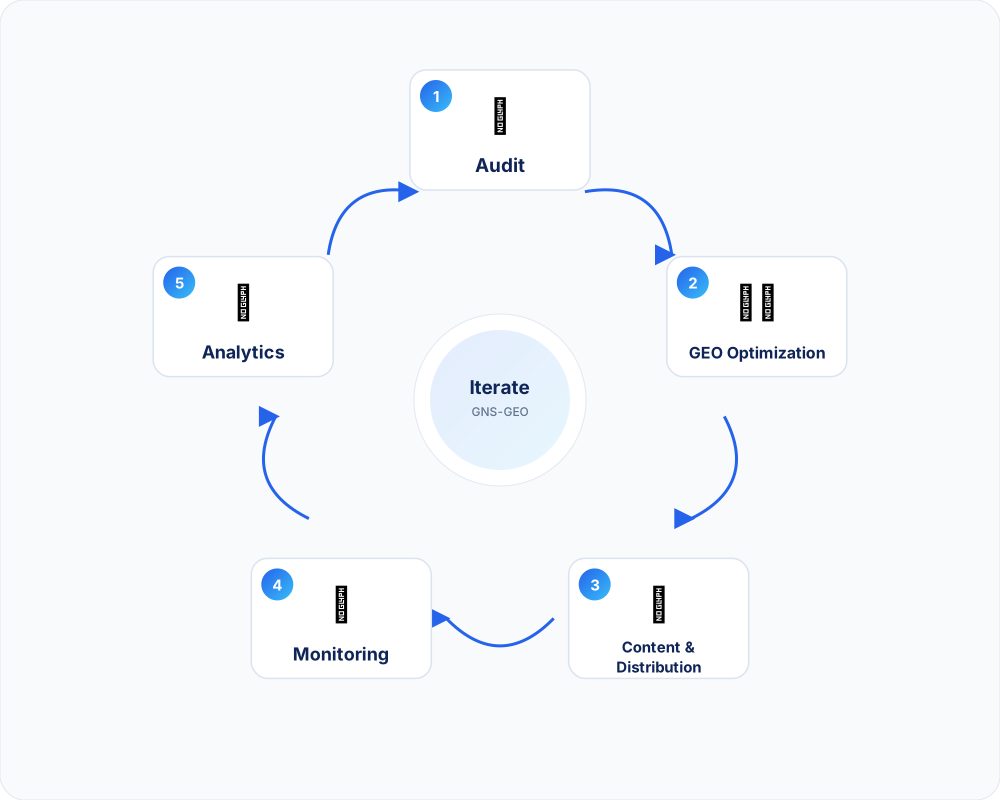
Figure: From audit to analytics and back to audit — AI visibility is a continuously iterating closed loop.
1. AI visibility audit: query Gemini with real questions, quantify citation count, visibility rate, and competitive gaps, and set a baseline.
2. GEO optimization: add Schema, rewrite direct answers, unify brand information, and make your website easier for AI to understand and cite.
3. Content & distribution: build articles, FAQs, comparison pages, and case studies around opportunity keywords, and distribute them to the right platforms.
4. Performance monitoring: continuously track changes in GEO score, mentions, share of voice, and citation rate.
5. Data analysis: turn insights into the next round of strategy, iterate continuously, and convert AI visibility from a one-off project into a system that grows sustainably.
Performance monitoring vs. data analytics: the microscope and the telescope
Many GEO providers treat monitoring and analytics as the same thing — show you a dashboard every month and call it done. But a dashboard only answers "what's happening right now." It can't answer three more important questions:
- Long-term trends: Is visibility rising or stalling over 6–12 months? Single-month numbers lie.
- How good is "good"?: Your GEO Score is 61 — is that high or low for your industry?
- Which decision actually moved the needle?: Of the three optimizations last quarter, which one actually drove citations up?
GNS-GEO separates the two:
- Performance monitoring (the microscope): tracks GEO Score, mentions, share of voice, and citation rate week by week, so execution stays on course.
- Data analytics (the telescope): uses long-term trends, causal attribution, industry benchmarks, and strategic recommendations to tell you what to change next quarter.
GNS-GEO's five levels of analysis
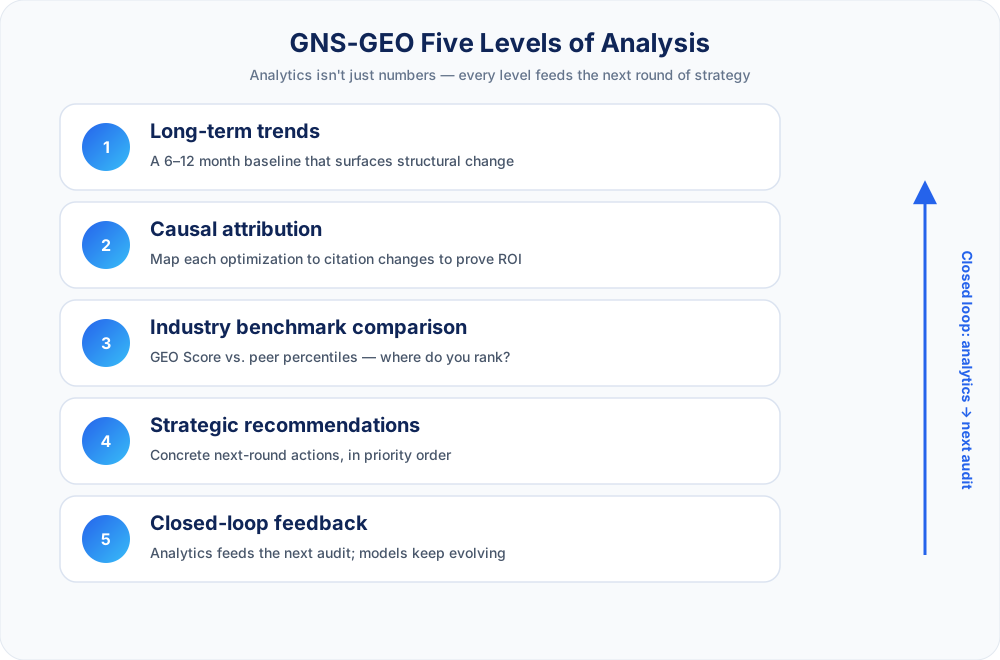
Figure: Analytics isn't just reporting numbers — from long-term trends to closed-loop feedback, every level feeds the next round of strategy.
- Long-term trends: a 6–12 month baseline that surfaces structural change, immune to single-month noise.
- Causal attribution: match each optimization against citation changes to know which investments actually pay off — no budget decisions on gut feel.
- Industry benchmark comparison: compare your GEO Score against peer percentiles — where does 61 rank in your industry, and who are you beating? This is exactly what sets GNS-GEO reports apart from "we only report your own score" tools.
- Strategic recommendations: not just numbers, but the next round of concrete actions in priority order.
- Closed-loop feedback: analysis feeds straight back into the next audit, evolving the question set, keyword library, and benchmark model — the fundamental difference between GNS-GEO and "open-loop" services that stop after five steps.
The GNS-GEO industry benchmark library: the foundation for answering "are we doing well?"
Most GEO tools only report your own scores — up 10% or down 5%, all absolute numbers that can't answer one question: "For your industry, is this score high or low?" The GNS-GEO industry benchmark library is a cross-client, cross-industry benchmark database built from years of Gemini audits and monitoring data. It powers the industry percentile in every report and is the data foundation for level 3, "industry benchmark comparison":
- Multi-industry depth: covers fintech, retail & e-commerce, professional services, healthcare, education, manufacturing, and more. Every industry has its own citation patterns — the weight of "authoritative media citations" in fintech is not the same as in retail & e-commerce; comparisons only make sense within the same industry.
- Multi-metric benchmarks: more than citation rate alone — it covers Gemini share of voice, content contribution, brand consistency, schema readiness, and other dimensions, each with industry percentiles.
- Continuously updated: the library grows with every new client audit and evolves alongside the Gemini algorithm itself — not a once-a-year static snapshot, but a continuously growing data asset.
When the CEO asks "are we actually doing well at GEO?" — the answer isn't "up 10% from last quarter", it's "you're at the Xth percentile in your industry, Y points behind the industry leader." That gap is next quarter's opportunity.
Delivery model: analytics built into the dashboard, not stacked in meetings
We don't pad value with "monthly review meetings" — strategy insights are built directly into the dashboard and the monthly strategy report, so leadership can access them anytime, and we only sit down together for deep-dive reviews:
- Dashboard strategy overview: every analysis insight lives in the strategy view of your report — GEO Score, citation trends, industry percentile — available anytime, with no need to adapt to meeting schedules.
- Monthly strategy report: an auto-delivered structured report with five parts:
- Monthly GEO performance overview: key KPIs month-over-month and year-over-year, key events, overall trajectory
- Gemini citation narrative health: the context and consistency of your brand's mentions inside Gemini answers
- Content ROI attribution: the actual citation contribution of each piece of content or optimization this month
- Industry benchmark comparison: your industry percentile, the gap to leaders, and the path to close it
- Next-quarter strategic recommendations: directional advice based on this month plus long-cycle data
- On-demand deep-dive review: when you surface critical questions from real leads, closed deals, or churn data, we run a deep-dive review and calibrate the question set and strategy together.
Appendix | Methodology Visualization & Research Data
GNS-GEO's scoring model is built on real AI citation data. The dashboard below shows the five dimensions of the GEO Health Score and the scale of the research:

Research scale:
- Brand-mention monitoring: brand recommendation patterns, industry keywords, and citation behavior in Gemini.
- Hong Kong industry query set: how Gemini selects citation sources based on Hong Kong users' search intent.
- Our own citation monitoring: the optimal Gemini citation paragraph is 134–167 characters; rich, visual content is cited 156% more often.
GEO vs traditional SEO vs paid ads chart
FAQ: GNS-GEO and Gemini Visibility
Q: There are many GEO companies — why choose GNS-GEO?
A: Three things set GNS-GEO apart. First, we focus exclusively on Google Gemini — we don't run one playbook across many platforms and force it to fit; every model and data point is built for Gemini. Second, we're locally rooted: our parent company GNS Technology Limited, founded in Hong Kong in 2019, is a system integrator serving government and large enterprises, so our technical and data foundations are solid. Third, our scoring model is built on our own monitoring of real Gemini citations — not guesswork.
Q: How long until GEO results show?
A: It depends on your site's foundation, but most clients see a clear rise in citation count and GEO Score within 4 to 8 weeks of completing the first round of recommendations (see the Chapter 05 case: GEO Score from 34 to 61 in 3 months). GEO compounds over time — the earlier you start, the earlier you build your citation advantage.
Q: Which GEO company is good? How do you choose?
A: Look for three things: real audit data (not just talk), a transparent scoring model, and local market experience. GNS-GEO lets you get a real Gemini visibility report for free — judge the data for yourself once you have it.
Q: What's the difference between the free report and paid GEO services?
A: The free report is the starting point — it shows where your brand stands in Gemini, your citation gaps, and priority improvements. You can act on it yourself, or, for faster results, GNS-GEO's five-stage closed-loop service handles everything from audit, optimization, content, monitoring, to analytics. Either way, the first step is the free report.
Q: What's the difference between performance monitoring and strategy analysis?
A: Monitoring answers "what's happening right now" — tracking GEO Score, mentions, and citation rate week by week so execution stays on course. Analysis answers "what does this mean, and what should we change next quarter" — layering long-term trends, causal attribution, and industry benchmarks on top of monitoring to turn raw data into strategic conclusions leadership can act on. Monitoring is eyesight; analysis is insight.
Q: What is the GNS-GEO industry benchmark library? Is the data reliable?
A: The benchmark library is a proprietary, industry-segmented reference dataset accumulated from years of Gemini audits and monitoring. It lets your citation rate, share of voice, and other metrics be interpreted against the right peer group — no longer isolated numbers, but relative position. Without benchmarks, more data is just absolute values; with benchmarks, you can answer the question management really wants to ask: "are we doing well?"
Q: We don't have a dedicated content team — can we still do GEO?
A: Yes. GEO doesn't require massive content — fixing the three basics of "direct answers + schema + consistent brand information" can already lift your chances of being cited. GNS-GEO's report gives prioritized recommendations, so you know what to do yourself and what to hand to us.
Q: Is GEO only for big companies with big budgets?
A: No. GEO's biggest advantage is that it doesn't require ad spend — it rewards content, structure, and authority signals, not whoever pays the most. Hong Kong SMBs can compete with big brands inside Gemini answers by building the right foundations. Register free and see where your starting point is.
30-Second Self-Test: Is Your Brand Ready to Be Cited by Gemini?
Six questions — answer "yes" or "no" honestly. The more "yes" answers, the stronger your GEO foundation; the more "no" answers, the more your report should prioritize.
- Does our website open with "direct answer" paragraphs that answer the core question up front?
- Have we implemented Organization and FAQ Schema structured data?
- Are our brand name, tagline, address, and contact details consistent across our website, LinkedIn, Google Business Profile, and other platforms?
- Do we regularly publish articles, FAQs, or comparison pages around industry keywords?
- Has our website published or updated content in the last 3 months (Gemini favors fresh content)?
- Do we know how many times our brand is currently mentioned in Gemini answers?
If most answers are "no", you're not alone — most Hong Kong brands are in the same position. The difference is that some companies have already started measuring. Get a free Gemini GEO report to turn "I don't know" into "I know", then improve item by item.
Conclusion
Gemini is redefining how brands get discovered. Brands that build their AI visibility foundations early will capture a place in Gemini answers before competitors even react.
The first step is always "measure." Get a free Gemini GEO report to understand your brand's current visibility rate, citation gaps, and priority improvements, then execute stage by stage with the five-stage framework.
The report is the baseline, optimization is the process, and being cited by Gemini is the goal.
About GNS-GEO
GNS-GEO is an end-to-end GEO framework focused on Google Gemini, providing Hong Kong businesses with AI visibility audits, GEO optimization, content strategy and distribution, performance monitoring, and data analysis services. To learn more, contact us at [email protected].