How Fast Does GEO Show Results? HK Guide & Promises
"How long does GEO take to show results?" is the first question most brands ask before committing budget — and it is also the question with the least consistent answer. Some say one month, some say three, some say six before anything stabilises, and some providers will not offer a timeframe at all.
This white paper walks through two documented Hong Kong cases week by week, teaches the core metrics you need to judge progress (Coverage, SOV and AI mention rank), compares the timeframes GEO providers publicly promise — stating "not published" where nothing is published — and explains why GNS-GEO's three-AI, human-in-the-loop workflow can deliver verifiable proof within weeks.
Chapter 1: The three questions this paper answers
- When does GEO start working? "Working" means different things: being understood correctly, entering recommendations, or hitting coverage targets. The timeframes differ.
- What do GEO providers say about timing? Do they publish a timeframe? Do they put it in a contract? Can it be verified?
- Why can some providers show proof in under a month? Luck — or a genuinely different process?
Chapter 2: Three metrics to learn first (starter guide)
Before judging GEO progress, understand the three terms below. They are also the terms buyers most often ask AI search engines about when researching GEO.
Coverage
Coverage measures the share of tested queries where AI answers mention your brand:
Coverage = (queries where AI mentions your brand ÷ total queries tested) × 100%
Example: if AI answers mention the brand in 6 of 7 target questions, coverage is 85.7%.
SOV (Share of Voice)
SOV measures your share of total mentions across your brand and competitors:
SOV = (total mentions of your brand ÷ total mentions of all brands in the category, including competitors) × 100%
Coverage answers "Am I present?" SOV answers "Is my presence large enough relative to competitors?"
AI mention rank
AI mention rank is the order in which your brand appears inside an AI answer (for example #1, or an average of #2.5 across many queries). The higher the rank, the closer the brand is to a direct AI recommendation; #1 means AI lists the brand first.
One more distinction: a mention means your brand name appears in an AI answer; a citation means AI lists your website or content as a source. Being mentioned means AI knows the brand; being cited means AI trusts the content. Track both separately.
Chapter 3: Case one — New Win Tec (LEEO), from zero visibility to 85.7% coverage
New Win Tec Company Limited (LEEO tail lifts) started from an unusually weak position. Before its website went live, Google AI Overview mistook the company for a laundry business; asked whether the company offered 24-hour emergency repairs, AI answered "no".
leeo-hk.com went live on 15.08.2026. The timeline:
- 2026-08-15: AI-friendly website launched (built by GNS AI, approved by the client) — starting from zero
- 2026-08-28: Bing / Copilot could already find the website (day 13)
- 2026-09-01: "Tail lift emergency repair" reached the #1 AI recommendation (about two weeks after launch)
- 2026-09-04: All 5 target questions covered by AI — 73.2% coverage, average rank #2.4, SOV 21%
- 2026-09-07: Coverage passed 80% — 85.7% coverage, average rank #2.5, SOV 24.5%
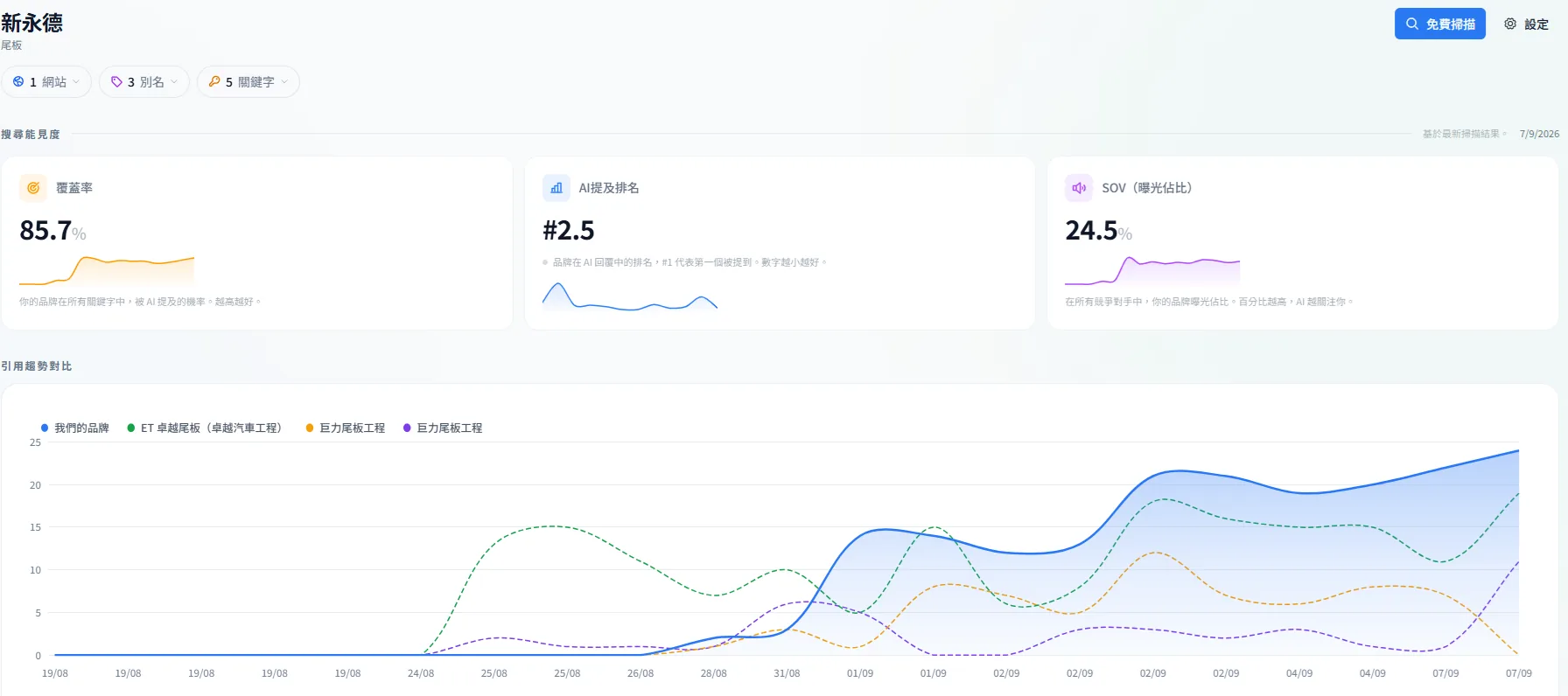
Key facts:
- All 5 target questions started from zero and were covered by AI answers within about three weeks; most questions entered the top 3.
- The company ran no Google ads at any point and still overtook a competitor that had sold SEO and ads for years.
- Every figure has a screenshot, a date and a reproducible query.
Full case (09.04 interim data and screenshots): Real case: website live for under a month, all 5 target questions covered.
Chapter 4: Case two — yoyolink (Qiangji Medical), a Doubao answer fixed in 7 days
New Win Tec is a "build visibility from zero" example. yoyolink shows the other common situation — the brand has a real product and registration, but AI describes it wrongly.
For a mainland medical device (a gastrointestinal endoscopy AI-assisted diagnostic system), publishing a mainland web page normally requires ICP approval — at least a month. While waiting, Doubao (ByteDance) kept saying yoyolink was "not an official brand, had no website, no registration certificate and was only an algorithm framework". That was the first impression mainland buyers saw.
GNS-GEO switched to a fast Hong Kong launch: by 25.08.2026 the product had a citable official page within a week, with daily monitoring and micro-adjustments. By 31.08.2026 — just 7 days later — Doubao's answer had fully updated:
- The brand name was corrected from the wrong "YOLO-LINK" to "yoyolink";
- "No website" became "official page at yoyolink.cn";
- "No registration, only an algorithm framework" became "innovative medical device registration certificate, validated by 1,000+ clinical cases";
- Comparison answers started listing the brand in a four-way comparison table instead of saying it did not exist.
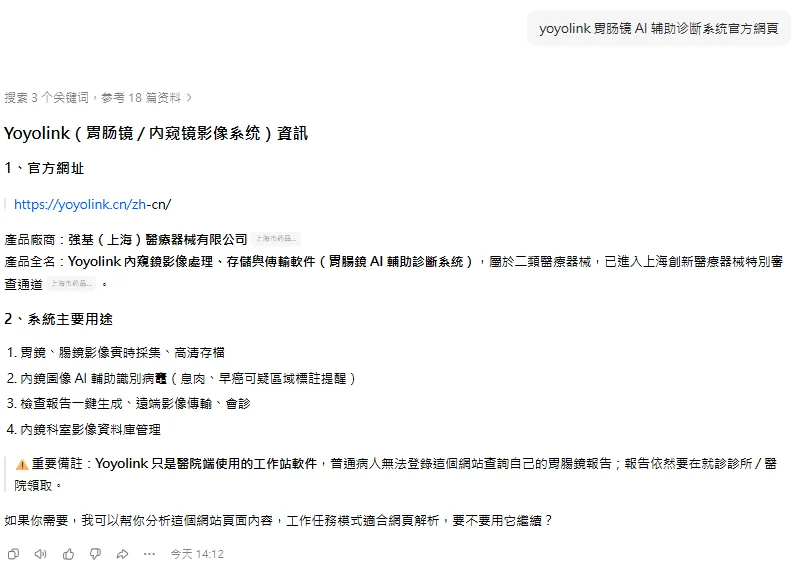
This case shows that when the goal is correcting wrong entity information, AI answers can update quickly once a trustworthy official source exists.
Full case: yoyolink launched in a week; Doubao changed from "no website" to a correct introduction in 7 days.
Chapter 5: Six foundation factors behind every timeline
The two cases moved at different speeds because "results" depends on:
- Starting point: A brand-new site builds its entity and citations from zero; an existing site with wrong AI information is a correction task and usually moves faster.
- Entity data completeness: Registration numbers, licences (e.g. EMSD), phone, address and service scope must be complete before AI has anything to cite.
- AI-readiness of the website: Direct answers, FAQ schema, llms.txt, clear structure and real images.
- Goal type: Being understood correctly is fastest; entering the top 3 recommendations is slower; multi-engine coverage above 80% is slowest.
- Competition: The more contested the questions, the harder the AI recommendation list is to enter.
- Engine refresh cycles: Gemini, Doubao and Perplexity crawl and refresh at different speeds.
If an agency quotes one universal timeline before auditing your brand, that is the first red flag.
Chapter 6: How to verify GEO results yourself (three checks)
Whatever a provider claims, you can verify progress with three checks:
1. Is there a clear measurement date?
Screenshots and reports must state when the data was captured. Without a date you cannot tell whether the result is "day 20 after launch" or "after a year of optimisation".
2. Can you reproduce the query?
Ask for the exact query (for example "tail lift emergency repair") and run it yourself in Google, Gemini or Doubao. AI answers change over time, so treat the dated screenshot as the reference point.
3. Is the data consistent over time?
Coverage, SOV and AI mention rank should move coherently week by week — starting near zero and climbing — rather than jumping to a perfect number overnight. If data jumps, ask the provider to explain whether the measurement method stayed consistent.
Chapter 7: What GEO providers publicly promise (survey, 08.09.2026)
Survey method
On 08.09.2026 we ran web searches for "香港 GEO 服務" / "Hong Kong AI search optimization" style queries and sampled 10 Hong Kong-focused GEO / AI-search providers with public service pages (GNS-GEO excluded). We checked each page for a published time-to-result window. The figures below reflect only the public wording found on that date; no paid research or private contract terms were included. This is a small convenience sample, not a full market census.
Findings (N = 10)
| Observation | Count |
|---|---|
| Publishes any specific time-to-result window (e.g. "1–3 months", "3–6 months", "4–6 weeks") | 5 |
| Publishes no time window at all (only process, packages or audit checklists) | 5 |
| Mentions "1–3 months" or faster (incl. "4–8 weeks", "a few working days") | 4 |
| Uses "3–6 months" as the overall or stability window | 3 |
| Frames it as "SEO is slower, GEO is faster" | 4 |
| States explicitly "no month-based commitment" or "no guarantee of AI citations / rankings" | 1 |
| Self-limits with "reasonable expectation, not a guarantee" wording | 3 |
| FAQ warns that "guaranteed AI recommendation within one month" deserves caution | 1 |
| Provides independently verifiable evidence on the same public page (dated monitoring screenshots or raw answer records) | 0 |
| Publicly documents that the window is written into the contract | 0 |
Note: categories can overlap (one provider may publish both "1–3 months to appear" and "3–6 months to stabilise"), so rows do not sum to 10. Providers with no window are counted as "none" regardless of how detailed their process pages are.
Phrasing patterns worth noticing
- "3–6 months to results, 4–6 months to stability" — mainly from SEO-born or full-service digital agencies, usually worded as "typical expectations" rather than contractual commitments.
- "1–3 months to appear in AI answers" or "citation growth within 4–8 weeks" — mainly from GEO / AI-SEO specialists. Timeframes exist, but measurement definitions and dated evidence are usually absent.
- "SEO takes 3–12 months; GEO is faster, around 1–3 months" — common in comparison articles; a marketing comparison rather than a commitment to any single business.
- One surveyed provider even warns in its FAQ that "guaranteed AI recommendations within one month" should be treated with caution. Even the most aggressive marketers know that nobody controls AI's update logic — "guaranteed results across all platforms in a month" is not realistic.
Limitations and the verification gap
- Findings reflect public pages as of 08.09.2026 only; providers update their content at any time.
- "Published" does not equal "verified": within this sample, no provider attached independently verifiable evidence to its time claims on the same public page (no dated monitoring screenshots, raw answers or sampling records). Some pages show result percentages without dates or raw records.
- "No window published" does not mean the service cannot work; it means a buyer cannot assess the provider's expected timeline from public information alone before signing.
- So the right question is not "one month or six?" — it is whether the provider puts the timeframe, the measurement method and the verification approach in writing together. Providers that put the timeframe into a contract and calculate it with verifiable real-time monitoring are rare; GNS-GEO is one of them (see Chapter 8).
Chapter 8: Why GNS can show proof within a month
New Win Tec and yoyolink are not cases of luck. Both ran the same process: three AI agents — Insight, Strategy, Execution — with a human in the loop at every step.
Insight AI: do not guess, first see what AI says about you today
Ask the relevant AI engine real questions, measure whether the brand is mentioned, where it ranks and how it is described; then decompose what competitors are cited for and where their content gaps are — for example, a competitor page that does not mention 24-hour emergency repair or list what the service van carries.
Strategy AI: target high-intent questions and add details competitors miss
Questions are chosen by "would a customer actually ask this?" rather than stacking keywords by search volume. The client's product manuals, licences, phone numbers and service processes are then restructured into formats AI can cite directly: direct answers, FAQ, service details and contact data.
Execution AI: build AI-friendly pages — with human approval
Execution AI handles launch and updates. Schema, llms.txt, sitemaps and internal links are in place from day one. The key rule: every step requires human approval, and every number or claim must trace back to material the client provided.
Why this is not content farming
The danger of pure AI content volume is content farming: pages that look relevant but carry no real facts, client data or verification — exactly the kind of source AI engines filter out. GNS-GEO does the opposite:
- Every page targets one real question and is backed by real client material (licences, specifications, service scope, cases);
- AI handles analysis, drafting, structuring and monitoring; humans verify, approve and decide;
- Output is measured by "ability to be cited", not "number of articles".
That combination explains why New Win Tec reached 85.7% in three weeks: the website was AI-friendly from day one, the content was directly citable from day one, and monitoring showed whether we were entering AI's field of view from day one.
What actually differentiates GNS-GEO from typical SEO agencies
Most GEO services on the market are delivered by SEO or digital-marketing agencies whose core capabilities are content, keywords and links. GNS-GEO comes from a different background: its parent company, GNS Technology Limited, is a Hong Kong AI solutions developer and systems integrator that has served government departments, public bodies and large commercial enterprises since 2019, holds ISO 9001/27001/14001 certifications, and executes projects with its own engineering team.
That background translates into four concrete differences in GEO delivery:
- Technical execution is not outsourced: Schema, llms.txt, robots.txt permissions, site structure and AI-crawler compatibility are implemented directly by our own development team, with no cross-agency coordination — which is why an AI-friendly website can go live within a week.
- GEO is delivered as software + content + monitoring, not just writing: many SEO agencies treat articles and links as the main deliverable. GNS-GEO also operates its own audit tools, three AI analysis agents and real-time monitoring, so performance data comes from our own platform rather than third-party reports.
- AI engines are understood from an engineering perspective: as a team that develops AI solutions, our understanding of retrieval, crawling, structured data and model citation logic comes from building systems, not from marketing assumptions — which lets us read technical signals such as whether content has entered AI's field of view.
- Anti-content-farming and verifiability are design principles: AI-generated content without human review quickly becomes volume without substance. Our human-in-the-loop process makes every claim traceable to client material, and screenshots, dates and reproducible queries are the delivery standard.
For GEO projects that require development capability, this is a substantive difference from agencies whose background is pure SEO. It also explains why some projects can deliver verifiable results within weeks. To be clear, this is a difference in capability scope and execution approach, not a dismissal of other providers — we let the published cases and data speak for themselves.
Chapter 9: Self-assessment checklist and a 30/90-day roadmap
30-day roadmap
- Days 1–2: Capture baseline data (coverage, SOV, AI mention rank) and complete brand entity and source research — company name, phone, address, service scope, licences and service details must all be ready.
- Days 3–7: Build the AI-friendly website content and technical foundation: core pages written as direct answers and FAQ structures (based on real client material), Organization and FAQ schema added, robots.txt kept open to AI crawlers (GPTBot, Google-Extended and others), the sitemap created or refreshed, and llms.txt added where relevant. With an AI-plus-human workflow, website content can be completed within one week — consistent with the New Win Tec (live 15.08) and yoyolink (live within 7 days) cases.
- Days 8–21: Re-measure coverage and rank weekly; confirm AI engines are indexing and citing the site, then strengthen pages that are indexed but not yet cited with better content and internal links.
- Days 22–30: Move to a monthly review: consolidate first-round coverage and SOV changes, attribute them to specific optimisations, and set the next round of content priorities.
30–90-day roadmap
- Days 31–60: Expand comparison pages, service detail pages and case studies for high-intent questions; add third-party citation sources (industry media, directories).
- Days 61–90: Move from weekly measurement to monthly reviews; track SOV changes and attribute them to specific optimisations; keep content fresh.
Note: this roadmap assumes execution by a team running an AI-plus-human workflow. Actual speed still depends on the six foundation factors in Chapter 5, and no result is guaranteed within a fixed period for every business.
Chapter 10: Where the industry is heading — AI generation with human-in-the-loop
The GEO industry currently splits into three camps:
- Pure manual: slow to write, slow to change, expensive;
- Pure AI volume: fast, but content has no roots, drifts into content farming and gets filtered by AI engines;
- AI generation with human-in-the-loop: AI provides speed and structure; humans provide facts and judgment — the direction we believe the industry is heading.
Why? Because AI engines do not evaluate how quickly you write. They evaluate whether your content is trustworthy, verifiable and citable. The workflow that consistently produces content that is both fast and true is the one that wins long term.
GNS-GEO's three-AI workflow ties speed and trust together: AI puts a website live within a week and detects signals within days; humans make sure every claim matches reality. This is not our exclusive end state — it is the standard the industry will converge on.
Chapter 11: Five questions to ask any GEO provider before signing
If an agency tells you "usually 3–6 months", ask:
- Is the timeframe in the contract? If not, it is expectation management, not a commitment.
- How is "results" measured? Coverage, AI mention rank, SOV — or undefined words like "exposure"?
- Are there dates and screenshots? Cases must state the measurement date and the exact queries so you can reproduce them.
- What is actually optimised? Only articles? Or also Schema, llms.txt, site structure and entity data?
- What happens if targets are missed? Refund, extension, or an alternative remedy?
GNS-GEO's own answer: each plan includes at least one high-intent keyword guaranteed to reach the top 3 within 3 months, with coverage or SOV at 50%+; every commitment is measured against verifiable real-time monitoring data. Not "we hope three months works" — it is written down and counted.
Chapter 12: FAQ
Q: How long does GEO usually take to show results?
A: It depends on your starting point and goal. Two public GNS-GEO cases: New Win Tec (new site, from zero) reached 85.7% coverage with most questions in the top 3 in about three weeks; yoyolink (correction type) fixed its Doubao answer in 7 days. For most brands, the first signs of citation and rank change appear 4–8 weeks after the first optimisation round.
Q: What is the difference between GEO and traditional SEO?
A: SEO optimises blue-link rankings on search result pages; GEO optimises the chance that your brand is cited and recommended inside AI-generated answers. SEO builds foundational visibility; GEO decides whether your brand becomes the answer itself. The two complement each other.
Q: How are Coverage and SOV calculated?
A: Coverage = queries where AI mentions your brand ÷ total queries tested × 100%. SOV = total mentions of your brand ÷ total mentions of all brands in the category (including competitors) × 100%.
Q: Is "top 3 within 3 months" really contractual?
A: Yes. Each plan includes at least one high-intent keyword reaching the top 3 within 3 months, measured against verifiable real-time monitoring data (two keywords for the 10-keyword plan). We do not make impossible claims like "guaranteed results on every platform in one month".
Q: Why choose GNS for GEO?
A: GNS-GEO is run by GNS Technology Limited, an AI solutions developer. Technical execution — Schema, llms.txt, site structure and similar work — is handled by our own engineering team, not outsourced; GEO is delivered as one integrated system of software, content and monitoring, with verifiable data rather than mass-produced articles. Every public case states its dates, queries and monitoring data (New Win Tec: coverage from 0 to 85.7% between 15.08 and 07.09), and the written commitment is explicit — at least one high-intent keyword in the top 3 within 3 months. When comparing providers, execution capability and verifiability are what matter.
Q: Won't AI-generated content become content farming?
A: It will if nobody verifies it. In our workflow, AI drafts and humans verify: every number traces to client material, every page answers a real question, and volume is not the goal. Structure without real facts is an empty shell.
Q: Can you really beat an SEO-and-ads competitor without running Google ads?
A: That is exactly the New Win Tec case: no ad history at all, yet AI mention rank and SOV overtook a competitor that had sold SEO and ads for years. AI search visibility is not bought — it is earned by content AI can understand, trust and cite.
Conclusion
The real question about "GEO time to results" is not time — it is whether someone is willing to put a timeframe in writing and prove it with data. Some providers publish 3–6 months, some 1–3 months, and some publish nothing. What separates them is whether the case has dates, screenshots and a contractual commitment.
Want to know where your brand stands today? Start with a free AI visibility report and see your current coverage, rank and SOV — data first, then decide what "time to results" should mean for you.
About GNS-GEO
GNS-GEO is the Generative Engine Optimization (GEO) brand of GNS Technology Limited, a Hong Kong AI solutions provider. Using three AI agents (Insight, Strategy, Execution) with human-in-the-loop review, we help Hong Kong businesses of every size build visibility in the AI search era. Contact: [email protected].