Articles
GEO for Engineering and Construction Firms: Why AI Does Not Recommend You
Engineering, renovation and equipment companies win work through word of mouth, but buyers now ask Gemini and Google AI Overviews who to hire. This guide explains why contractors disappear from AI answers, what buyers actually ask, six GEO actions you can take now, and the Everpeak Engineering case that went from zero visibility to the top AI recommendation in a month.
Anson Ng
19 min read
How did clients find engineering firms before? They asked a friend, checked word of mouth, and phoned around for prices. Today there is an extra step: they ask AI first.
"Who sells tailgate safety systems?" "Which renovation contractor is good?" "How much does it cost to fit a tailgate?" Buyers hand these questions to Gemini and Google AI Overviews, which generate a single answer listing a few companies. If you are not in that answer, you never get the chance to quote.
The direct conclusion: engineering, renovation and equipment firms are the most likely to disappear from AI search — and the reason is usually not an ugly website, but a website AI cannot read. Below: why it happens, what buyers actually ask, and six things you can do now.
Why engineering firms disappear from AI answers
| Common situation | Why AI does not recommend you |
|---|---|
| The site is mainly a portfolio or photo gallery | Images only, no factual text, so AI has nothing to extract |
| Service coverage is vague | "Serving all of Hong Kong" with no areas or service types is hard for AI to match |
| You speak in trade jargon | Buyers search "tailgate", you write the technical product name, so the two never connect |
| Company details are inconsistent | Name, address and phone differ across platforms, so AI cannot confirm who you are |
| No structured data | Machines have to guess what you offer; if the guess is wrong they quote someone else |
| Almost no third-party material | AI finds no outside source confirming your credibility |
Most engineering firms are not "missing" — they are present but not clear. To an AI engine, unclear is the same as missing.
What buyers actually ask AI
AI queries in engineering and renovation fall into three layers, each closer to a sale than the last:
| Stage | Example buyer questions | Value to you |
|---|---|---|
| Understanding | "What are the safety risks of a tail lift?" "What do I do first when renovating?" | Builds professional credibility |
| Comparing options | "Infrared or laser tailgate safety system — which is better?" "Full or partial renovation?" | Gets you onto the shortlist |
| Choosing a supplier | "Who sells tailgate safety systems?" "Which renovation company in [district]?" "How much roughly?" | Produces actual quote requests |
The third layer is where the business is. The problem: if you only publish first-layer educational content and never answer "who does it, how much, in which area", AI will not mention you at the third layer.
Six GEO actions an engineering firm can take now
1. Open every service page with a direct answer
State in one paragraph: who you are, what service you provide, which clients you serve, which areas you cover. For example:
"Everpeak Engineering is a Hong Kong commercial vehicle safety equipment company specialising in infrared and laser tailgate safety systems, serving fleets and vehicle owners across Hong Kong."
AI favours this "answer it in one paragraph" format. Avoid openings like "leading the industry, pursuing excellence".
2. Write case studies as facts, not photo albums
For each project, state the project type, the location or sector, the problem, the solution you used and the outcome. Every image needs a text caption and alt text. AI needs text — images alone count as no content.
3. Write FAQs in the customer's own words
Customers do not say "hydraulic tail lift platform"; they say "tailgate". Use the exact wording buyers type, then answer it directly underneath. Add FAQPage structured data so machines can extract the answer cleanly.
4. Publish certifications, safety and compliance information
Engineering and renovation are trust-driven. Put licences, accreditations, safety standards and insurance on the website, and link to sources that can be checked. AI prefers claims that are backed up.
5. Make your brand entity signals consistent
Your company name, address, phone number and opening hours must match across your website, Google Business Profile, social media and industry directories. AI uses these signals to confirm who you are; inconsistency creates doubt.
6. Build third-party corroboration
AI looks beyond your own website. Trade association listings, media coverage, customer reviews and partner pages all reinforce credibility. It works best when third parties describe your brand in the same terms you use.
Real case: Everpeak Engineering, zero visibility to the top AI recommendation in a month
Everpeak Engineering (EPE) is a Hong Kong commercial vehicle safety equipment company focused on infrared and laser tailgate safety systems. It already had a website, but the pages were written for people who already knew the brand — the questions buyers actually ask had no direct answers, and the company details were not consistent. The result: Gemini did not recommend EPE at all for "who sells tailgate safety systems".
After optimisation (consistent brand entity, direct-answer content, structured data):
- Searching "尾板安全系統邊個買" (who sells tailgate safety systems) in Google AI Overview, Everpeak Engineering ranks first
- Its core keyword also reached first position in Google Search in the same period
- Timeline: zero visibility to the top AI recommendation in roughly one month
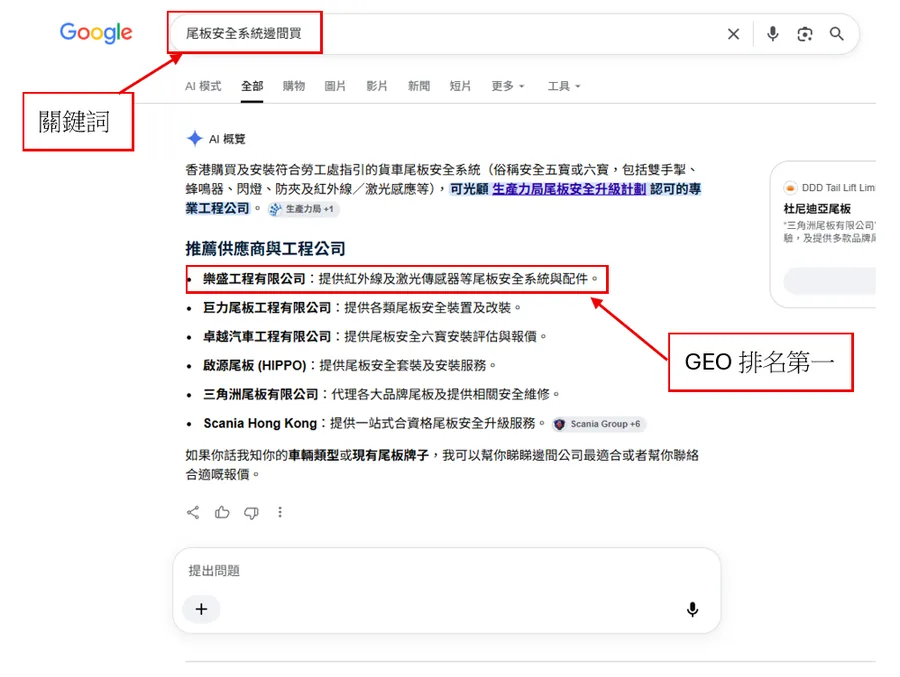
The full record is in the Everpeak Engineering case study.
How long does it take?
It depends on the website baseline and the competition. In general:
- First free report: most firms already see clear gaps (missing structured data, outdated content, no third-party citations)
- 4 to 8 weeks after the first optimisation round: AI citation rate and coverage begin to rise
- Ongoing: review coverage, AI mention rank and share of voice monthly, and expand the keyword set gradually
Any promise of "all platforms within one month" is unrealistic.
Common questions
Q: We are a small firm with two technicians. Is GEO relevant? A: Yes, and it can work even better. Small firms are usually more focused — one type of project, one district. Describe that focus precisely and AI can match you to relevant queries more easily than a large firm that cannot be that specific.
Q: Do we need to rebuild our website for GEO? A: Not necessarily. If the site structure is sound, you usually only need to rewrite the key pages, add structured data and unify the company details. GNS-GEO's service includes one web page build, which suits firms without a suitable landing page or with a page that needs rebuilding.
Q: Our projects come from referrals. What does AI visibility actually add? A: Referrals remain the main source, but after a referral most buyers check you online. If AI cannot say who you are or what you have done, the referral loses credibility. If AI recommends you unprompted, that is an extra independent endorsement.
Q: How do we know whether AI mentions us today? A: Ask Gemini and Google AI Overviews your high-intent questions directly, and record whether you are mentioned, which position you hold, the date you tested and the platform you tested. To measure it systematically, request the free AI visibility report.
Summary
Clients in engineering and renovation have already handed the "who should I hire" question to AI. Appearing in those answers depends not on how good the website looks, but on whether the content is clear, specific and verifiable: a direct answer, real project cases, FAQs in the customer's language, accreditations, consistent company details and third-party corroboration.
To see where your firm actually stands in AI search, start with the free AI visibility report or request a quote.
Further reading: How to get Gemini to recommend your brand, GEO contracts and KPI acceptance guide, Measuring GEO performance: coverage and share of voice, Hong Kong GEO service pricing guide
FAQ
Our engineering firm relies on referrals. Is GEO worth it?
Yes, and the case is stronger than for most industries. Engineering, renovation and equipment firms have high order values and long decision cycles, and buyers usually ask AI who to hire and roughly what it costs before they ever request a quote. If the AI answer does not include you, you never reach the quotation stage. Referrals still matter, but they have to be turned into public, machine-readable information before AI can use them.
Do buyers really search AI for this kind of B2B work?
They do, and mostly late in the decision. Buyers typically use AI first to understand what is required, what safety standards apply and what the market price looks like, then ask who to hire. Those are high-intent queries, so being mentioned in them converts far better than general traffic.
What content should an engineering firm publish to be cited by AI?
AI wants specific, verifiable facts rather than adjectives. The most effective content includes: a direct-answer paragraph at the top of every service page (what you do, which clients you serve, which areas you cover), real project case studies (project type, location, problem solved), clear answers to common questions, certifications and safety standards, and checkable company details (name, address, phone, licence).
How long does GEO take for an engineering firm?
It depends on the website's baseline and keyword competition. Most firms already see clear gaps in the first free AI visibility report. After the first optimisation round, AI citation rate and coverage typically start to rise within 4 to 8 weeks. In the Everpeak Engineering case, the company went from zero visibility to the top Google AI Overview recommendation within about a month.