Articles
Hong Kong medical GEO case study: how A1 Imaging reached 85.1% average coverage in under a month
A medical GEO case study of A1 Integrated Medical and Imaging Centre: all 5 questions above 50% coverage in under a month, 85.1% average, AI mention rank #2 and 5/5 cited. Includes the measurement method, limitations and three live Google screenshots.
Anson Ng
17 min read
A1 Integrated Medical and Imaging Centre (A1 CT Scanning Limited) launched its AI subdomain info.a1-imaging.com in the first week of October. The latest GNS-GEO report (23–29 October, 17 scans, 5 keywords) shows: 85.1% average coverage, AI mention rank #2, SOV 25.8%, and all 5 questions cited.
The client's original target was 50%+ average coverage across 5 questions within 3 months. In reality, coverage reached 85.1% in under a month — about 35 percentage points above target and more than two months early.
How the results are measured
- Fixed query set: the same 5 questions throughout the period; keywords are not swapped based on performance.
- Scan count: 17 scans between 23 and 29 October, each recording the date, surface (AI Overview or AI Mode) and a screenshot of the original answer.
- Coverage: scans mentioning the brand ÷ total scans × 100%. For example, 15 mentions out of 17 scans is about 88%.
- AI mention rank: where the brand first appears in the AI answer; #1 means mentioned first.
- SOV: brand mentions ÷ all brand mentions (including competitors) for that question.
These definitions match our GEO metrics guide, so clients can repeat the same queries and verify the numbers.
Latest performance across the 5 questions
| Keyword | Coverage | AI mention rank |
|---|---|---|
| Best value PET-CT imaging centre in Hong Kong | 62% | #4.5 |
| Private CT/PET waiting times, report turnaround and expedited service | 97% | #1.9 |
| Private CT with medical vouchers or direct billing (AIA, Bupa, HSBC) | 96% | #3.3 |
| Collecting private CT images and reports, and uploading to eHealth | 77% | #2.5 |
| Private PET scan in Kowloon (PSMA, C11 and Amyloid) | 93% | #4.7 |
All five questions are above 50%, with a low of 62% and a high of 97%. The waiting-time and voucher/direct-billing questions now appear almost every time they are asked.
Three live Google searches
The screenshots below were captured from Google Search on 29 October 2026, showing the actual AI Overview answers.
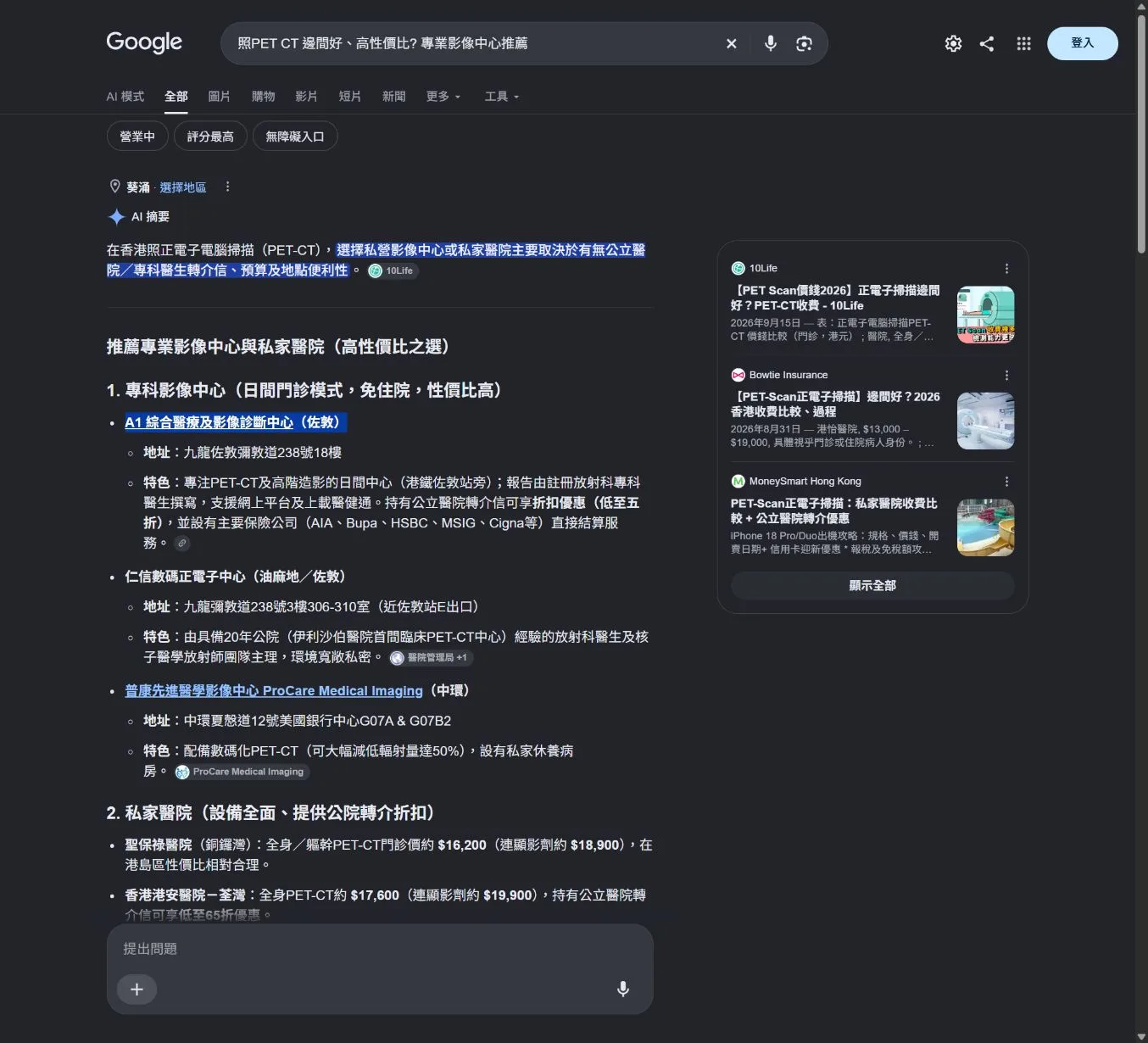
The AI Overview lists A1 first, including the address, the centre's focus, the public-hospital referral discount and direct billing with major insurers.
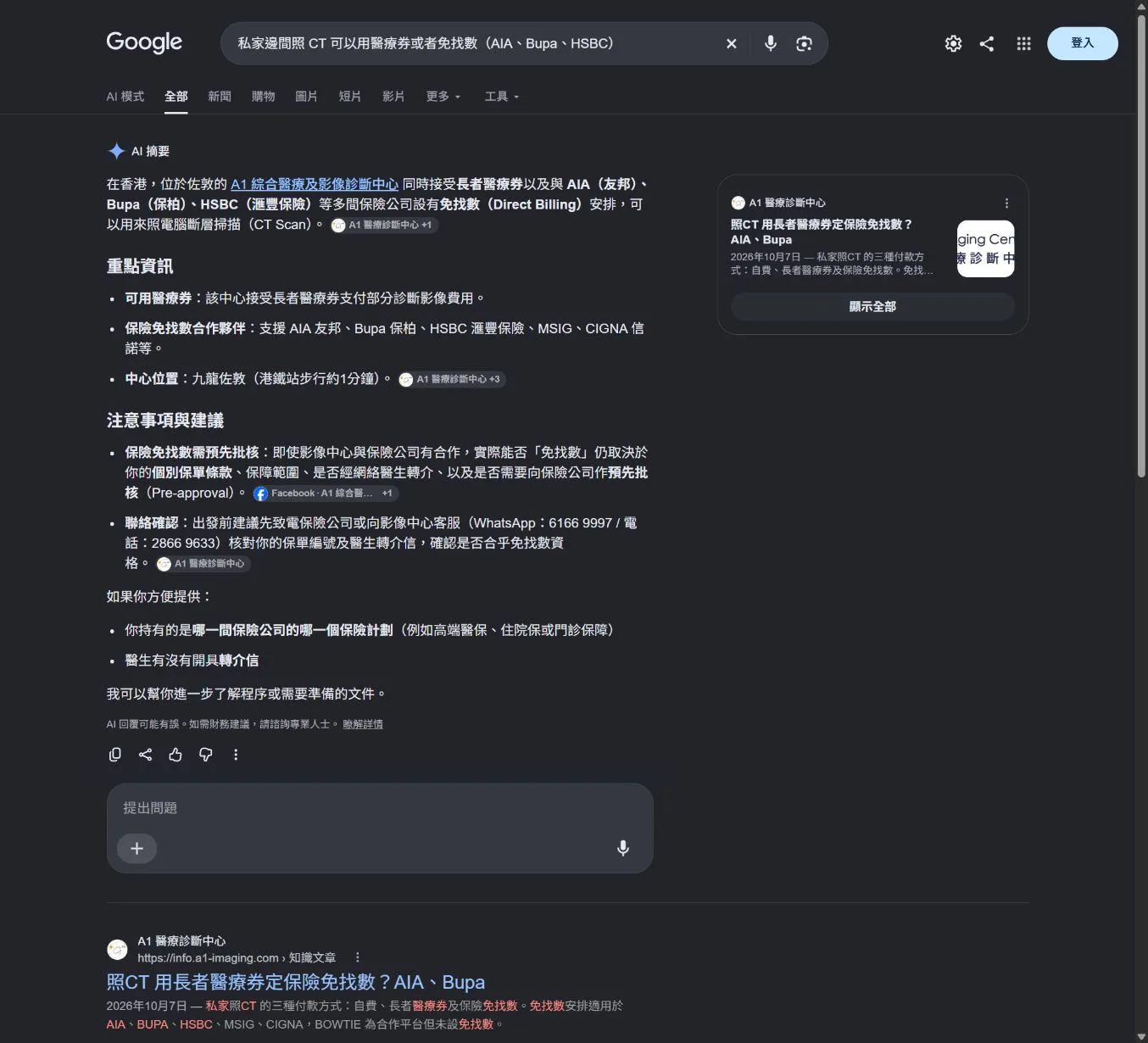
This answer cites the centre by name and sets out voucher eligibility, the direct-billing insurer list and pre-approval requirements — a format AI can extract cleanly.
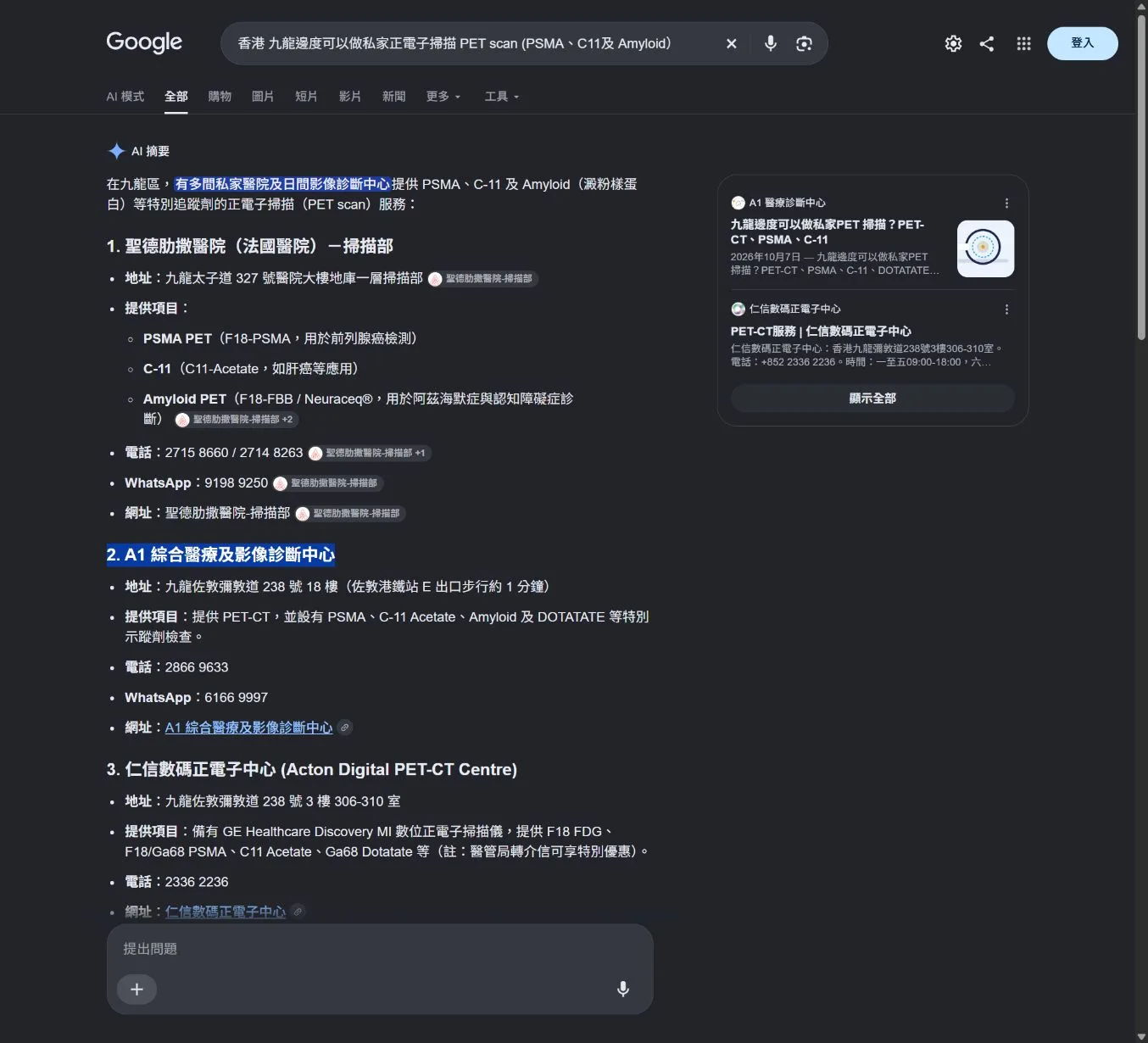
A1 appears second, with its address, phone number, WhatsApp contact and range of special tracers including PSMA, C-11 Acetate, Amyloid and DOTATATE.
The hardest part: verifying medical content
Medical content is different from typical product content. Every figure and every service detail has to be checked repeatedly with suppliers and the client team, for example:
- Whether a particular tracer is available and whether it requires booking
- Whether pricing is still valid and how the referral discount is calculated
- The insurer list for direct billing and pre-approval requirements
- Report turnaround, collection methods and eHealth upload arrangements
A single error can affect a patient's decision, so content cannot be published first and corrected later. This content took several times longer than typical commercial work. That verification is also why the answers AI cites are stable and checkable.
Technical approach: the AI subdomain
A1's results came from an architectural choice: leave the main site unchanged and add an AI-facing subdomain under the existing domain.
- Main site untouched, two tracks in parallel: the existing site structure, design and booking flow stay as they are, avoiding rebuild cost and compliance risk.
- A separate GEO layer: the subdomain carries Schema, llms.txt and content written for AI Overview and Gemini.
- Independent measurement: subdomain performance is reported separately from the main site.
This external-layer approach suits healthcare groups and other organisations whose main site needs multiple approvals to change or is constrained by a legacy system. For the architecture, implementation steps and limitations, see What is an AI subdomain?.
Next steps
- The average rank is #2, with two questions at #4.5 and #4.7; work will focus on their answer structure and citation sources
- Continue scanning the same query set weekly to see whether coverage holds above 85%
- Extend coverage to adjacent questions on pricing, insurance and report processes
Limitations and how to read the numbers
- One client, one market: these are A1's results and do not represent every medical provider.
- AI answers fluctuate: 17 scans is a one-week sample — enough to show direction, not permanent stability.
- Screenshots age: Google AI Overviews change over time and by location, so a later reproduction may differ.
Frequently asked questions
What are A1 Imaging's latest figures?
23–29 October, 17 scans, 5 keywords: 85.1% average coverage, AI mention rank #2, SOV 25.8%, with all 5 questions cited. Per-question coverage ranges from 62% to 97%.
Has the target been met?
The client's official target was 50%+ average coverage across 5 questions within 3 months. The subdomain launched in the first week of October and reached 85.1% in under a month — about 35 percentage points above target and more than two months early.
Why does medical content take longer?
Medical content involves tracer supply, pricing, insurance direct billing, report turnaround and eHealth arrangements. Every item must be checked repeatedly with suppliers and the client team. A single error can affect a patient's decision, so content cannot be published first and corrected later. It takes several times longer than typical commercial content.
How were the screenshots obtained?
The three screenshots were captured from Google Search on 29 October 2026, showing the actual AI Overview answers. AI answers change over time and by location, so they may differ slightly if reproduced later.
What happens next?
The average rank is #2, with two questions still at #4.5 and #4.7. The next step is to improve the answer structure and citation sources for those two, and to keep scanning the same query set weekly to see whether coverage holds above 85%.
Summary
A1's AI subdomain has been live for less than a month, and all 5 questions are above 50% coverage, averaging 85.1%, with two close to 97%. Behind those numbers is a verification process that makes medical content far slower to produce. The next step is to push the two lower-ranked questions higher.
For how we charge for GEO, see our GEO pricing standard. To find out which GEO approach suits your industry, start with a free AI visibility report.
FAQ
What are A1 Imaging's latest figures?
23–29 October, 17 scans, 5 keywords: 85.1% average coverage, AI mention rank #2, SOV 25.8%, with all 5 questions cited. Per-question coverage ranges from 62% to 97%.
Has the target been met?
The client's official target was 50%+ average coverage across 5 questions within 3 months. The subdomain launched in the first week of October and reached 85.1% in under a month — about 35 percentage points above target and more than two months early.
Why does medical content take longer?
Medical content involves tracer supply, pricing, insurance direct billing, report turnaround and eHealth arrangements. Every item must be checked repeatedly with suppliers and the client team. A single error can affect a patient's decision, so content cannot be published first and corrected later. It takes several times longer than typical commercial content.
How were the screenshots obtained?
The three screenshots were captured from Google Search on 29 October 2026, showing the actual AI Overview answers. AI answers change over time and by location, so they may differ slightly if reproduced later.
What happens next?
The average rank is #2, with two questions still at #4.5 and #4.7. The next step is to improve the answer structure and citation sources for those two, and to keep scanning the same query set weekly to see whether coverage holds above 85%.